
(Written & Translated by C.S.GAO )The imbalance of vascular endothelial immune homeostasis after ischemic stroke (IS) is a critical pathological process that exacerbates blood–brain barrier (BBB) breakdown and neutrophil infiltration. Consequently, achieving non-invasive and precisely targeted delivery to ischemic endothelial cells to maintain their immune homeostasis remains a major challenge in the field of neurovascular research.
To address this clinical bottleneck, a team led by Professor Wu Jian—Dean of the School of Healthcare Management at Tsinghua University, Director of the Neurological Center at Beijing Tsinghua Changgung Hospital, and Principal Investigator at the Tsinghua-IDG/McGovern Institute for Brain Research—recently published their latest original research. The study identifies the CD151 protein as a key molecular regulator of cerebral endothelial immune homeostasis following IS. Furthermore, the team developed a targeted delivery system (Exo-siCD151) using exosomes derived from endothelial cells pretreated with oxygen-glucose deprivation (OGD). Leveraging the natural homing effect of these exosomes, intravenously injected Exo-siCD151 effectively restores the immune homeostasis of brain endothelial cells, repairs the BBB, and improves neurological outcomes. This work not only expands our understanding of the immunomodulatory properties of post-stroke endothelial cells, but also offers a novel targeted therapeutic strategy for BBB repair .
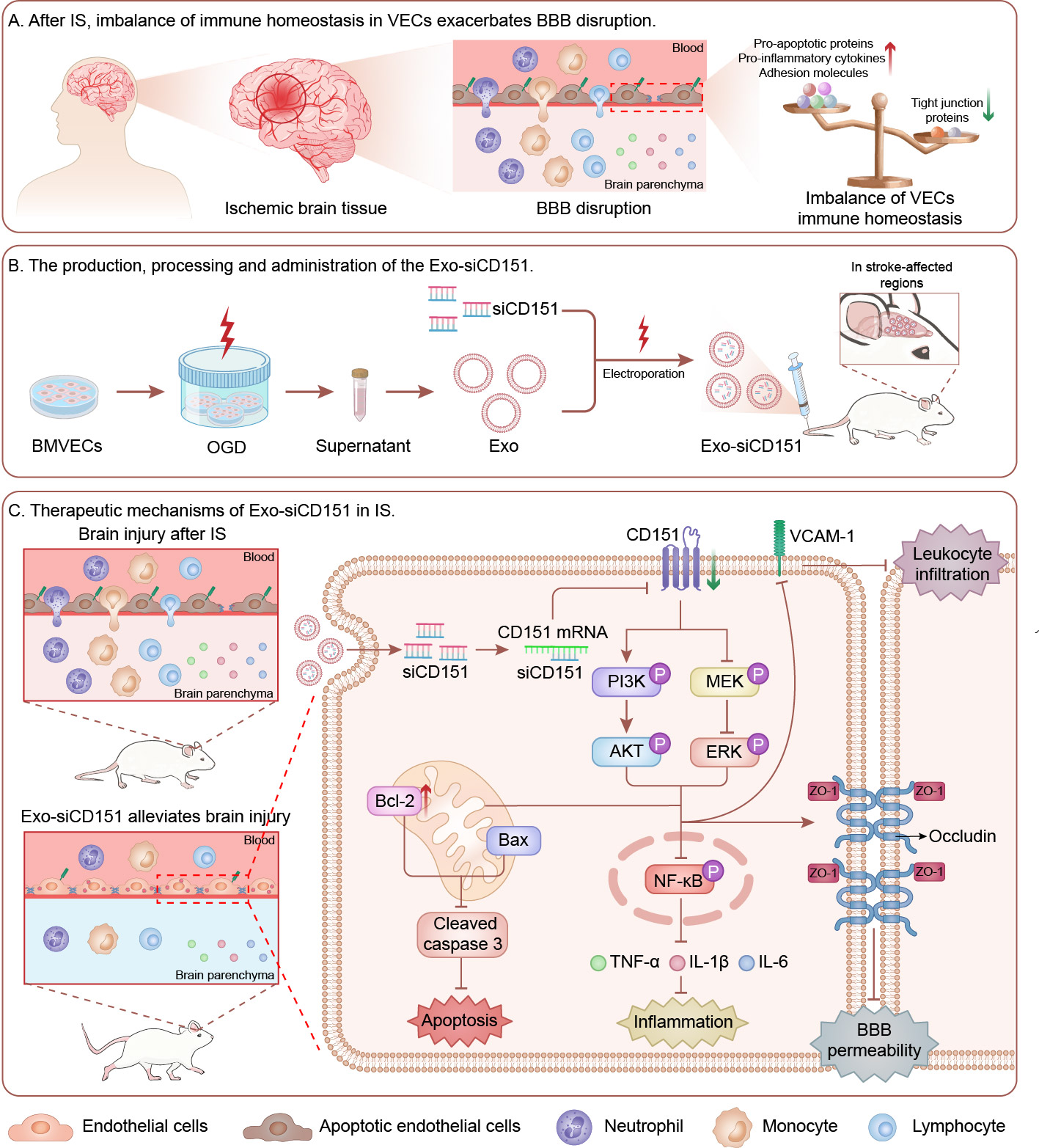
Figure 1. Exo-siCD151 alleviates blood-brain barrier disruption after ischemic stroke by maintaining immune homeostasis in brain endothelial cells
Results
1、CD151: A Key Regulatory Molecule of Brain Endothelial Cell Immune Homeostasis After IS
We first performed transcriptome sequencing and analyzed the enrichment of differentially expressed genes (DEGs) after cerebral ischemia. Interestingly, we found that CD151 was enriched within the molecular function of "cell adhesion molecule binding," a pathway closely linked to immune homeostasis. Our further validation confirmed that CD151 was significantly upregulated in brain endothelial cells subjected to OGD. Additionally, our team’s previous representative study demonstrated that downregulated CD151 alleviated brain injury after IS. Therefore, the present study aims to deliver CD151 siRNA (siCD151) to downregulate CD151, thereby achieving precise regulation of endothelial immune homeostasis.
2、Constructing an Exosome Delivery System (Exo-siCD151) for Highly Efficient Targeting and Neuroprotection
To deliver siCD151 to ischemic endothelial cells safely, efficiently, and target-specifically, this study innovatively utilized exosomes derived from OGD-pretreated brain microvascular endothelial cells (BMVECs)—termed OGD-Exo—as a carrier. This system features the following advantages:
① Homing and Targeting Capability: As the "parent cells," the OGD-pretreated BMVECs secrete exosomes that can target and home in on damaged endothelial cells through an intrinsic homing mechanism, successfully delivering siCD151 to achieve gene silencing.
② Therapeutic Efficacy: Three days post-administration, the treatment group exhibited a remarkable improvement in neurological deficit scores. Concurrently, infarct volume and brain edema were significantly reduced, the BBB integrity was almost fully restored, and the infiltration of peripheral immune cells (neutrophils and monocytes) into the brain parenchyma was markedly diminished.
③ Stability: The OGD-Exo effectively protect the loaded siRNA from enzymatic degradation.
④ Safety Profile: This delivery system demonstrates excellent biocompatibility and biosafety during both the acute and chronic phases following IS.
3、Exo-siCD151 restores endothelial immune homeostasis by modulating the MAPK/ERK and PI3K/Akt signaling pathways.
Both in vitro and in vivo , Exo-siCD151 restored the immune homeostasis of ischemic endothelial cells, characterized by suppressed endothelial apoptosis (evidenced by increased Bcl-2), reduced pro-inflammatory cytokine levels (decreased TNF-α, IL-1β, and IL-6), diminished adhesion molecule expression (decreased VCAM-1), and elevated tight junction protein levels (increased ZO-1 and occludin). Mechanistically, this molecular regulation involved the inhibition of the MAPK/ERK signaling pathway and the activation of the PI3K/Akt signaling pathway.
This research orchestrates three major strategies: endothelial immune homeostasis remodeling, precise exosome targeting, and highly efficient siRNA silencing. It not only uncovers a novel molecular target for the acute phase treatment of IS but also provides compelling experimental evidence for the application of exosomes in drug delivery for neurological disorders. Moving forward, the research team will further explore its potential for clinical translation.
This work was published in the Journal of Nanobiotechnology under the title "T argeted exosome-delivered CD151 siRNA maintains brain endothelial cell immune homeostasis to alleviate blood-brain barrier disruption after ischemic stroke ". Xu Lu, a Class of 2023 PhD student, and Dr. Zhao Yating, a postdoctoral fellow from the School of Clinical Medicine at Tsinghua University, are the co-first authors of the paper. Professor Wu Jian and Dr. Gao Ceshu, a postdoctoral fellow from the School of Clinical Medicine at Tsinghua University, serve as the co-corresponding authors. This study was funded by grants from the National Natural Science Foundation of China and the National Key R&D Program of China.
Paper Link: https://link.springer.com/article/10.1186/s12951-026-04467-2