
(Translated By JI.F.S.& WANG.X.D.)The intricate interplay between tumors and the immune system has not only deepened our understanding of cancer biology but has also driven a paradigm shift from fundamental research to clinical immunotherapy, marking a milestone in modern oncology. As research continues to advance, accumulating evidence highlights the critical role of neural signaling in tumor initiation, progression, and invasion. Tumor neurobiology has thus emerged as a frontier field with significant implications for both basic research and clinical translation.
Perineural invasion (PNI), a pathological hallmark of aberrant tumor–nerve interactions, represents a key indicator of aggressive behavior in multiple solid tumors, including cholangiocarcinoma and pancreatic cancer. Clinically, PNI is closely associated with local recurrence, distant metastasis, and poor prognosis, making it one of the major pathological factors limiting long-term survival. Despite its clinical importance, the spatial organization and molecular regulatory mechanisms underlying PNI have remained poorly understood.
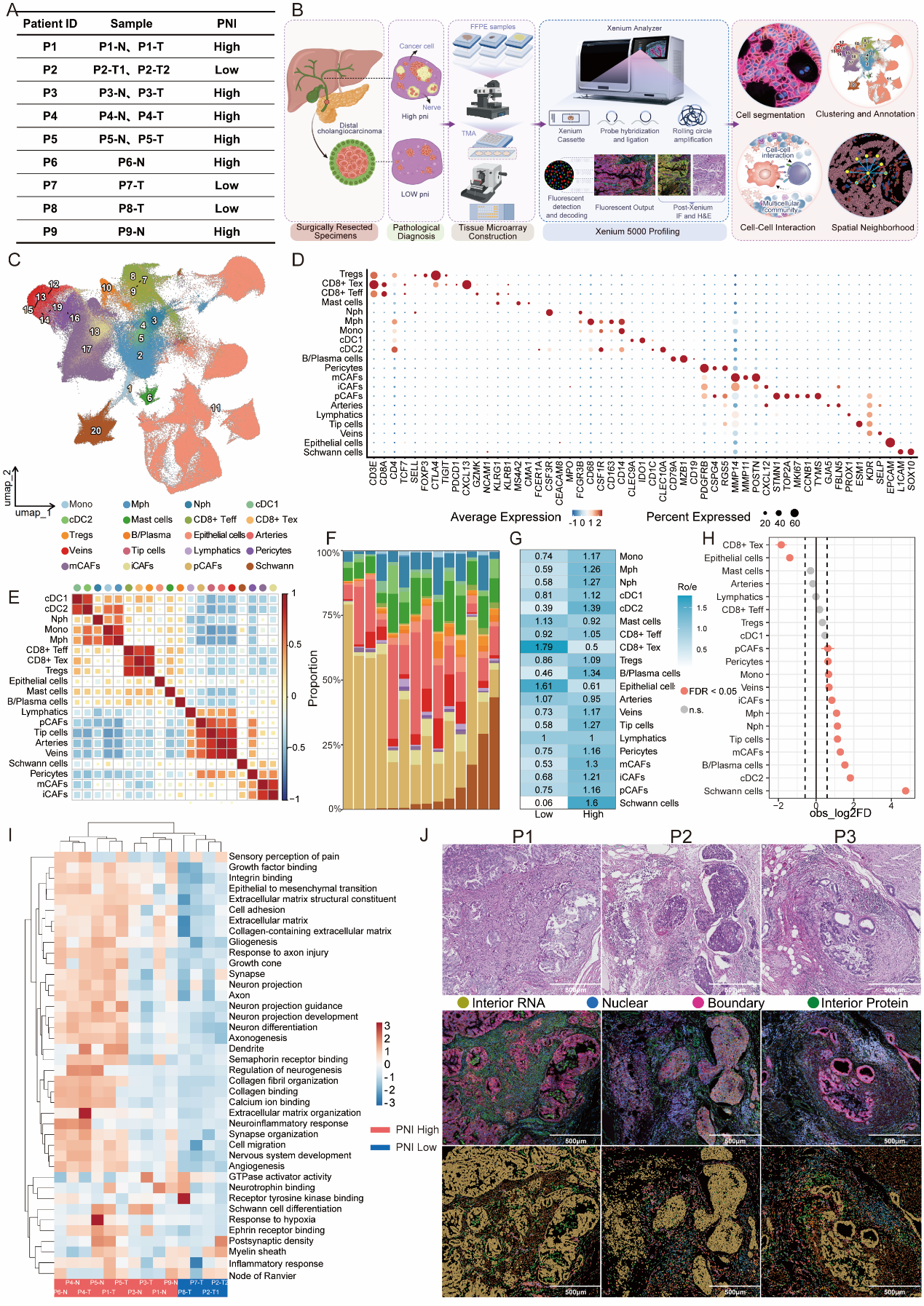
Recently, a research team led by Academician Dong Jiahong at the Hepatopancreatobiliary Center, Beijing Tsinghua Changgung Hospital, in collaboration with the Department of Pathology headed by Dr. Hongfang Yin, achieved a major breakthrough in the study of neural–tumor interactions in distal cholangiocarcinoma (dCCA). For the first time internationally, the team applied Xenium subcellular-resolution spatial transcriptomics to systematically dissect the cellular and molecular architecture of the PNI microenvironment in dCCA, generating the first high-resolution spatial cellular atlas of perineural invasion in dCCA.
By integrating spatial transcriptomics with high-resolution pathological morphology, the study constructed a comprehensive PNI spatial atlas encompassing over 350,000 spatially resolved single cells across 20 major cell types. Within a unified tissue framework, the researchers achieved precise spatial registration of H&E staining, immunofluorescence imaging, and spatial transcriptomic signals, enabling an accurate reconstruction of key cellular interactions and molecular events within the perineural invasion niche.
Building on this atlas, the team systematically annotated all PNI-positive regions across pathological sections for each patient and introduced a patient-level Perineural Invasion Density Index (PNI density index) normalized to tumor size. This quantitative metric enabled refined stratification of patients based on PNI burden. Comparative analyses revealed that tumors with high PNI density exhibited significant upregulation of pathways related to neurogenesis, axon regeneration, extracellular matrix remodeling, and Schwann cell differentiation, compared with tumors showing low PNI involvement.
These findings suggest that tumor cells do not merely spread passively along nerve fibers but actively acquire neurotropic invasive capabilities through a process of “neural education,” providing new mechanistic insights into the aggressive behavior of distal cholangiocarcinoma and opening avenues for targeted therapeutic intervention.
This study is titled A Subcellular Spatial Atlas Illuminates the Microenvironmental Remodeling of Perineural Invasion in Distal Cholangiocarcinoma and was published in the Journal of Hematology & Oncology. Ji Fansen, a research fellow at the Hepato-Pancreato-Biliary Center of Beijing Tsinghua Changgung Hospital, Chen Hao, a doctoral student at the Hepato-Pancreato-Biliary Center, and Li Huan, a pathologist at the hospital, are the co-first authors of this paper. Academician Dong Jiahong, the president of Beijing Tsinghua Changgung Hospital, Wang Xuedong, associate chief physician theHepato-Pancreato-Biliary Centerrof Beijing Tsinghua Changgung Hospital, Yin Hongfang, the director of the Pathology Department, and Tang Bingjun, a physician at the Hepato-Pancreato-Biliary Center, are the co-corresponding authors of this paper. The entire technical staff of the Pathology Department also made significant contributions to this research. This study was supported by the National Natural Science Foundation of Chinese Integrated Project "Research on the Visualization Guidance of Key Molecular Functions of Neural Invasion in Biliary Malignant Tumors for Precise Surgery".
Link:https://link.springer.com/article/10.1186/s13045-025-01773-4