
(Author / X.X.ZHAI Reviewed by / Y.PAN)Recently, the team led by Professor Pan Yu from the Department of Rehabilitation Medicine at Beijing Tsinghua Changgung Hospital, in close collaboration with Professor Dou Weibei’s team from the Department of Electronic Engineering at Tsinghua University, published their latest original research in the authoritative international neurorehabilitation journal Neurorehabilitation and Neural Repair.
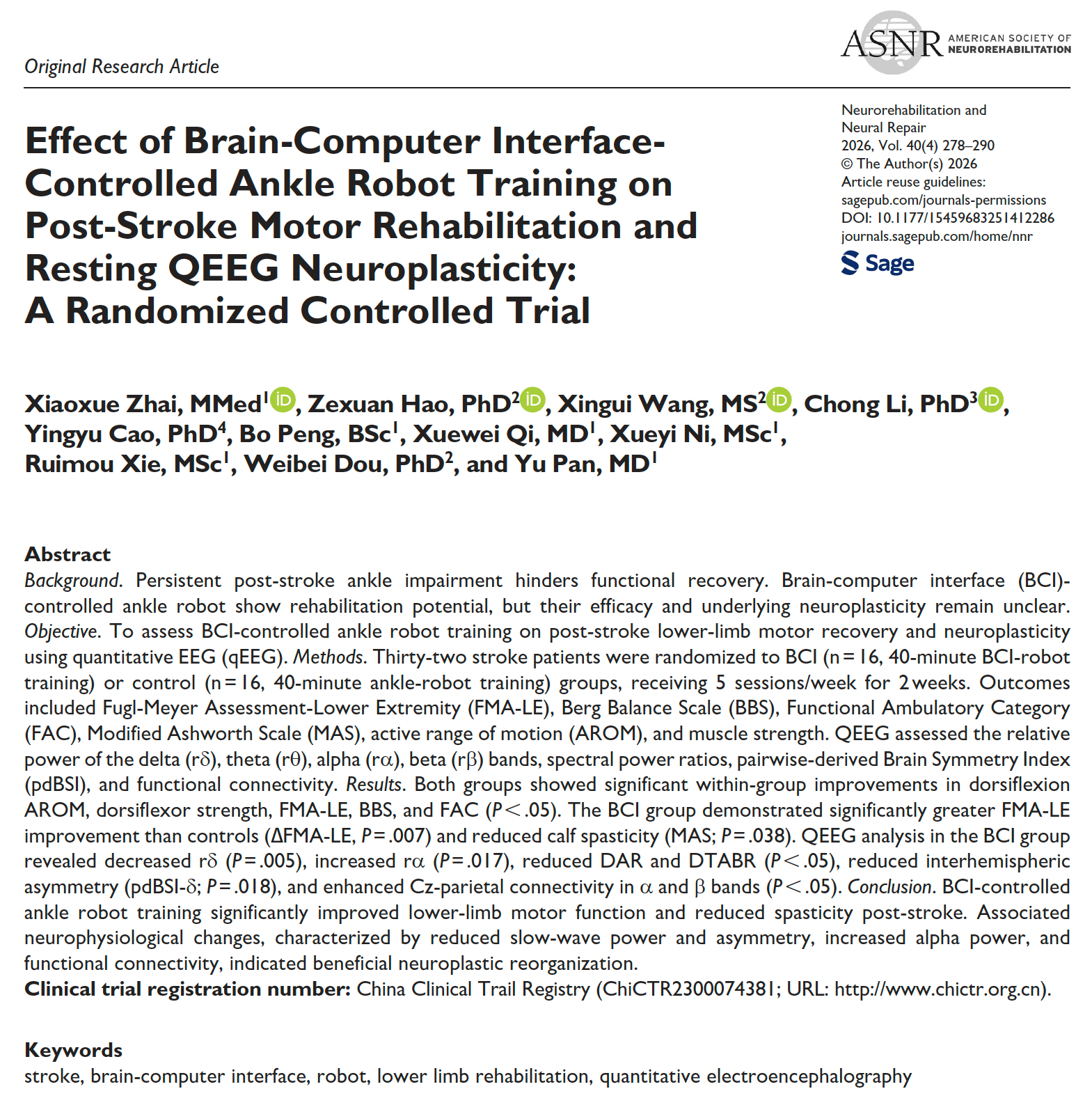
The paper, titled “Effect of Brain-Computer Interface-Controlled Ankle Robot Training on Post-Stroke Motor Rehabilitation and Resting QEEG Neuroplasticity: A Randomized Controlled Trial”,delves into how closed-loop Brain-Computer Interface (BCI) ankle robot training based on motor imagery promotes lower limb motor function recovery and brain neuroplasticity in stroke patients through a rigorous randomized controlled trial.
Stroke is one of the leading causes of chronic disability among adults worldwide. Lower limb motor control impairments, such as foot drop and foot inversion, severely affect patients' gait balance and activities of daily living (ADL). While traditional passive ankle rehabilitation robots can improve joint range of motion to some extent, they struggle to effectively stimulate the active participation of the patient's cerebral cortex, often leading to a bottleneck in motor function recovery.
To address this clinical pain point, the research team independently developed an ankle BCI training system based on motor imagery. This system can decode the patient's scalp electroencephalogram (EEG) signals in real-time as they “attempt to move the affected ankle”. When the correct motor intention is recognized, it triggers the ankle robot to provide precise proprioceptive and multimodal (visual, auditory, tactile) feedback (Figure A and B). This design successfully constructs a “central-peripheral-central” closed-loop sensorimotor circuit, aiming to promote brain reorganization through active neuromodulation.
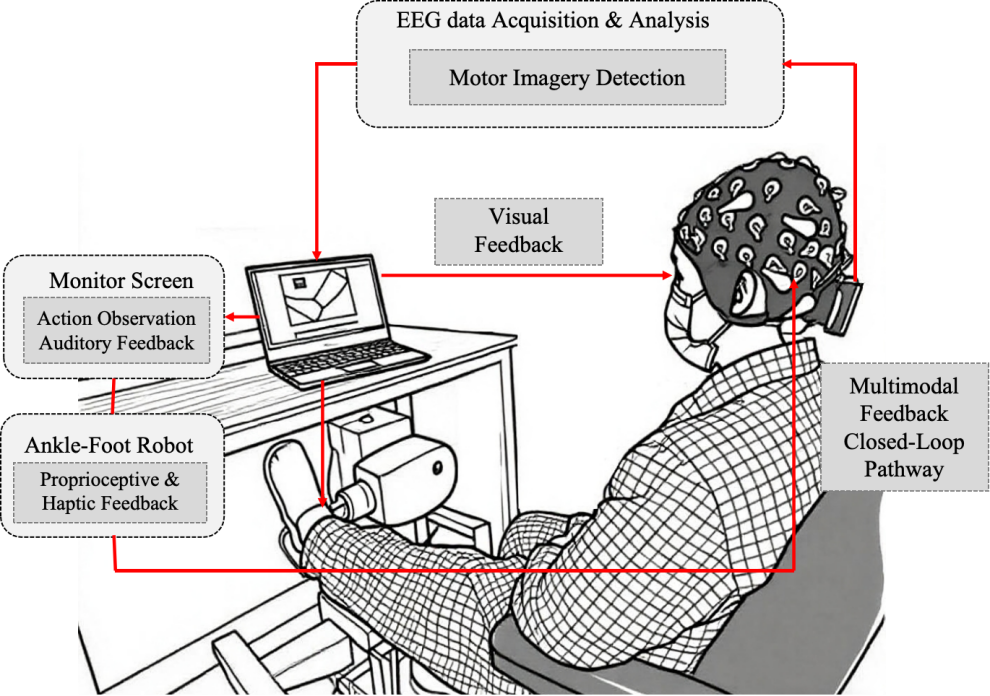
A. Schematic Diagram of Brain-Computer Interface Training
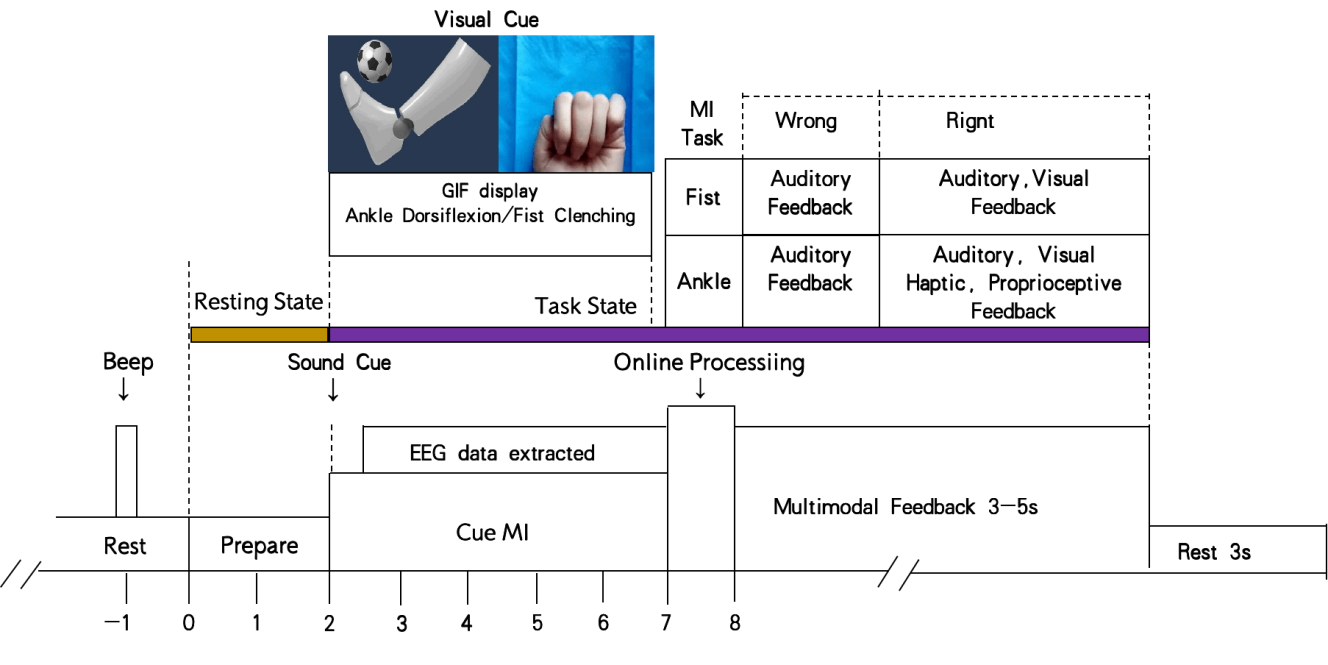
B. Timing for kinesthetic motor imagery and robotic feedback.
To verify the clinical efficacy and neural mechanisms of this system, the research team conducted a single-blind randomized controlled trial. Thirty-two stroke patients were randomly assigned to either the BCI intervention group (receiving BCI-controlled ankle robot training) or the control group (receiving conventional passive ankle robot training). Both groups underwent intensive training for 2 weeks, 5 sessions per week, with each session lasting 40 minutes.
The study results showed:
· Significant Improvement in Clinical Function: After 2 weeks of training, both groups showed significant improvements in active dorsiflexion range of motion, dorsiflexor muscle strength, Berg Balance Scale (BBS), and Functional Ambulation Category (FAC). However, the BCI group significantly outperformed the control group in the improvement of the Fugl-Meyer Assessment for Lower Extremity (FMA-LE) scores, and demonstrated a unique, significant therapeutic effect in alleviating triceps surae spasticity (Modified Ashworth Scale, MAS).
· Revealing the Mechanisms of Neuroplasticity Remodeling: Through high-time-resolution quantitative EEG (qEEG) analysis, the study provided objective electrophysiological evidence that ankle BCI intervention promotes brain functional reorganization. The results indicated that after training, patients in the BCI group exhibited significantly decreased slow-wave (delta) power, increased alpha power, and significantly improved interhemispheric symmetry (pdBSI-δ). Simultaneously, functional connectivity in the Cz-parietal region was significantly enhanced in the alpha and beta frequency bands. These characteristics closely align with the EEG patterns of healthy individuals, marking the effective repair of the brain's sensorimotor network.
This study not only confirms the outstanding efficacy of BCI-controlled ankle robot training in improving lower limb motor function and reducing muscle spasticity after stroke, but more importantly, it reveals the underlying mechanisms by which closed-loop intervention induces benign changes in brain neuroplasticity through multi-dimensional qEEG metrics. This achievement lays a solid evidence-based medical foundation for the clinical application of BCI technology as a targeted and precise neurorehabilitation strategy.
The first author of this paper is Dr. Zhai Xiaoxue, an attending physician at the Department of Rehabilitation Medicine, Beijing Tsinghua Changgung Hospital. Professor Pan Yu of Beijing Tsinghua Changgung Hospital and Professor Dou Weibei of the Department of Electronic Engineering, Tsinghua University, are the co-corresponding authors. This research was funded by the National Key Research and Development Program of China, among other projects.
Paper Link: https://doi.org/10.1177/15459683251412286