(Written & Translated by Z.LI )Recently, the team led by Professor Zhou Li, Director of the Vita Tech Innovation Center at Beijing Tsinghua Changgung Hospital, has made important progress in the fields of diabetic chronic wound healing and bioabsorbable bioelectronics. The work was carried out in collaboration with the National Center for Nanoscience and Technology, the team led by CAS Academician Chunying Chen at the Suzhou Institute of Nano-Tech and Nano-Bionics, Chinese Academy of Sciences, and the team led by Associate Professor Han Ouyang at the University of Chinese Academy of Sciences. The findings, entitled “Restoration of endogenous electric fields with a glucose-powered symbiotic bioabsorbable bandage for diabetic wound healing,” were published in the international academic journal Science Advances .
Diabetic chronic wounds are difficult to heal and remain a major challenge in clinical treatment. Their occurrence and progression are closely associated with the hyperglycemic microenvironment, persistent inflammation, insufficient angiogenesis, and impaired endogenous electric fields. During normal wound repair, tissue injury induces the formation of endogenous electric fields, which regulate cell migration, immune responses, and tissue regeneration. However, in the high-glucose environment associated with diabetes, this critical bioelectrical signal is weakened, thereby impeding the wound-healing process. To address this challenge, the research team proposed a symbiotic bioelectronic strategy based on the concept of using “pathological metabolites as therapeutic energy sources.” By converting excess glucose in the wound into sustained electrical stimulation signals, the strategy enables synergistic therapy through local glucose consumption and restoration of the endogenous electric field.
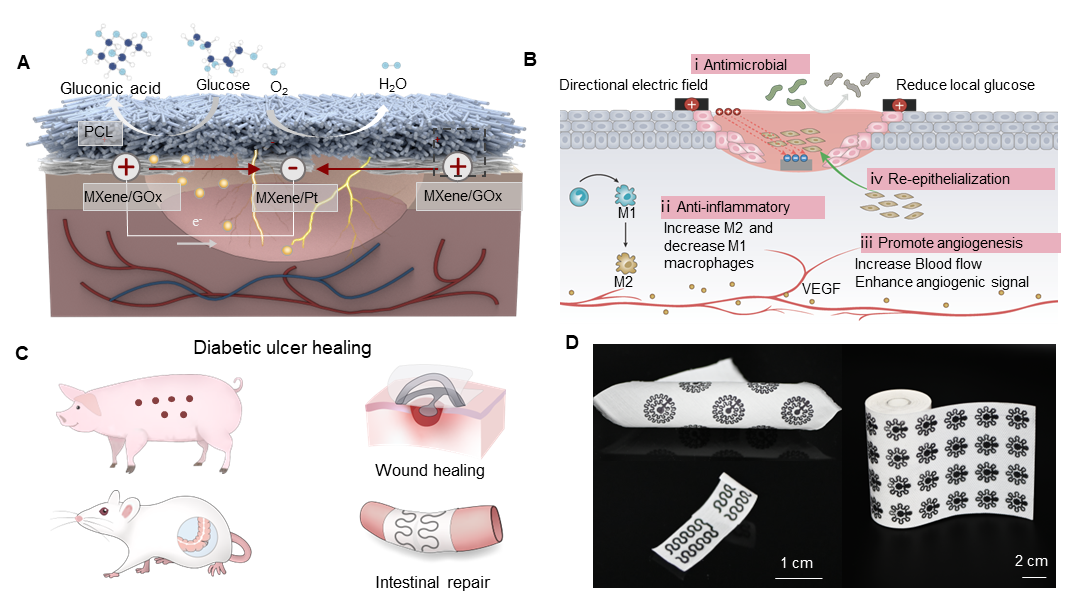
Working Principle and Physical Demonstration of the Glucose-Powered Bioabsorbable Electronic Bandage
The electronic bandage consists of an electrospun polycaprolactone, or PCL, fiber substrate, an MXene/glucose oxidase anode, and an MXene/Pt cathode. The PCL fiber substrate provides the device with excellent flexibility, breathability, tissue conformability, and bioabsorbable properties. The MXene functional layer offers outstanding charge transport capability and enhances catalytic performance, thereby improving the device’s energy conversion efficiency and electrical stimulation performance.
In terms of device fabrication, the research team employed a mask-assisted spray-coating process to achieve regular patterned integration of functional electrodes on the flexible PCL substrate. This method does not require complex micro- or nanofabrication, precise transfer printing, or multi-step assembly. Instead, controllable electrode patterning can be realized simply through mask design and spray deposition. The process features simple operation, customizable patterns, good reproducibility, and scalability, providing a feasible technical pathway for the large-scale fabrication of flexible and bioabsorbable electronic bandages.
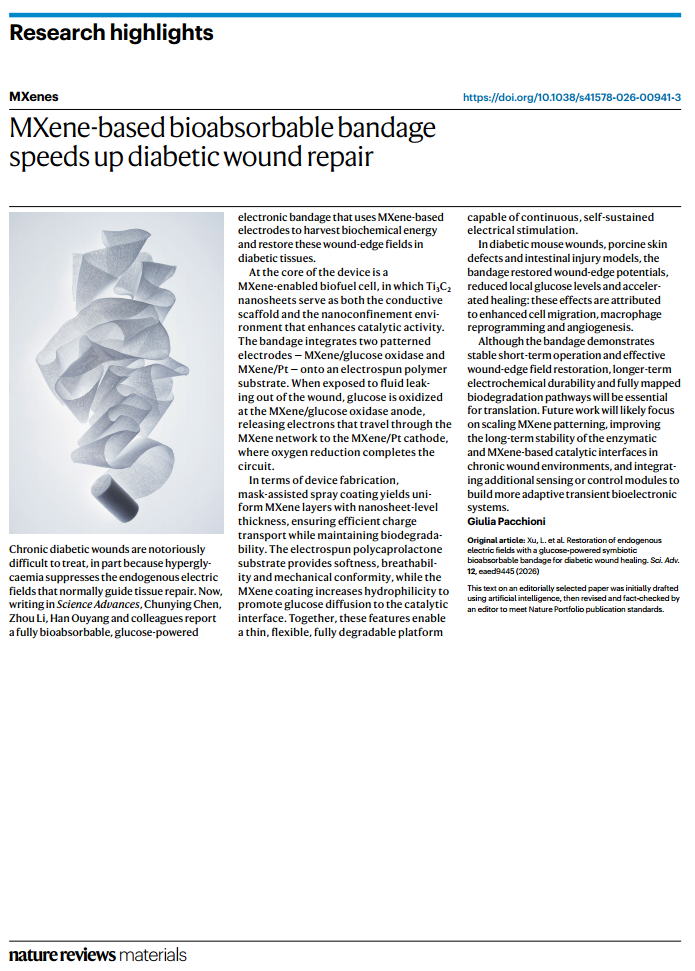
Since its publication, the study has attracted attention from the international academic community. On June 29, 2026, Giulia Pacchioni, Chief Editor of the internationally authoritative journal Nature Reviews Materials , featured the work in a Research Highlight entitled “MXene-based bioabsorbable bandage speeds up diabetic wound repair.” The article highlighted the fully bioabsorbable, glucose-powered electronic bandage developed in this study, with particular emphasis on its use of MXene-based electrodes to harvest biochemical energy from wounds and restore electric fields at wound edges. It also noted the integration of self-powered electrical stimulation into a flexible and degradable device. These design features demonstrate the innovative value of this work in diabetic chronic wound healing and bioabsorbable bioelectronic devices.
The paper’s co-corresponding authors are Professor Zhou Li of Beijing Tsinghua Changgung Hospital, CAS Academician Chunying Chen of the National Center for Nanoscience and Technology, and Associate Professor Han Ouyang of the University of Chinese Academy of Sciences. Dr. Lingling Xu, now an Associate Research Fellow at the University of Chinese Academy of Sciences, is the first author.
This research was supported by the National Natural Science Foundation of China, the New Cornerstone Science Foundation, the Youth Innovation Promotion Association, Chinese Academy of Sciences, the Strategic Priority Research Program of the Chinese Academy of Sciences, the Beijing Natural Science Foundation, the Beijing Nova Program, and the Fundamental Research Funds for the Central Universities.
Research Highlight: https://www.nature.com/articles/s41578-026-00941-3
Paper: https://www.science.org/doi/10.1126/sciadv.aed9445